Getting Hydrogen Peroxide Levels Right: A Guide to Testing Methods
Effective hydrogen peroxide-based water system disinfection depends on achieving and verifying the correct hydrogen peroxide concentration throughout the system for the required contact time.
If the concentration is too low, disinfection may be ineffective. Too high, and you risk unnecessary chemical use, potential material impact, and inefficiency.
That’s why accurate testing of hydrogen peroxide levels isn’t just a formality - it’s fundamental to proving a disinfection has been carried out correctly.
For any queries and questions about this post, please contact us.
Blog Archive
Why Accuracy Matters
Not all testing methods provide the same level of accuracy. The method you choose should reflect:
• The concentration you are targeting
• The level of precision required
• Where in the system you are testing
This is particularly important at sentinel points, such as:
• Cold water storage tanks
• Calorifiers (or as close as possible)
• Furthest points on hot and cold water services
These locations confirm whether the required concentration has been achieved across the entire system - not just at the point of dosing.
With increasing focus from the Legionella Control Association (LCA) on the accuracy of testing, particularly at sentinel points, it’s becoming more important than ever to understand the strengths and limitations of each testing method.
Testing Methods: What Are Your Options?
There are four main methods used to measure hydrogen peroxide levels:
1. Test Strips
2. Colourimetric Test Kits
3. Drop Test Kits (Titration)
4. Photometric Testing (Spectrophotometers)
Each offers a different balance between speed, cost, and accuracy.

Test Strips: Indicative, Not Definitive
Test strips are widely used for quick checks:
✔ Fast
✔ Simple
✔ Low cost
However:
• They provide only an approximate concentration range
• Results are subjective, depending on colour interpretation
• They are not sufficiently precise for verifying critical concentrations
As such, they are best used as a screening tool (i.e. confirming presence and general distribution) rather than for accurate measurement.
Drop Test Kits: Quantifiable, But Operator-Dependent
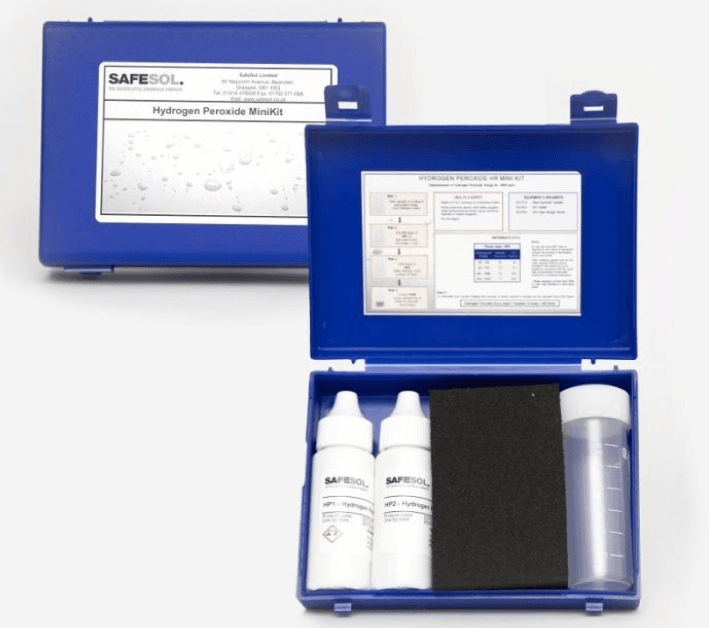
Drop test kits (titration) provide a numerical measurement of hydrogen peroxide concentration, making them more suitable for validation at sentinel points.
Typical process:
• A measured sample is taken
• Reagents are added until a colour change occurs
• Concentration is calculated based on the reagent volume used
Advantages:
✔ Provides ppm (mg/L) readings
✔ More accurate than test strips
Limitations:
• Accuracy depends on precise sample measurement and consistent drop technique
• Higher concentrations require dilution, increasing potential for error
• Small inconsistencies can significantly affect results
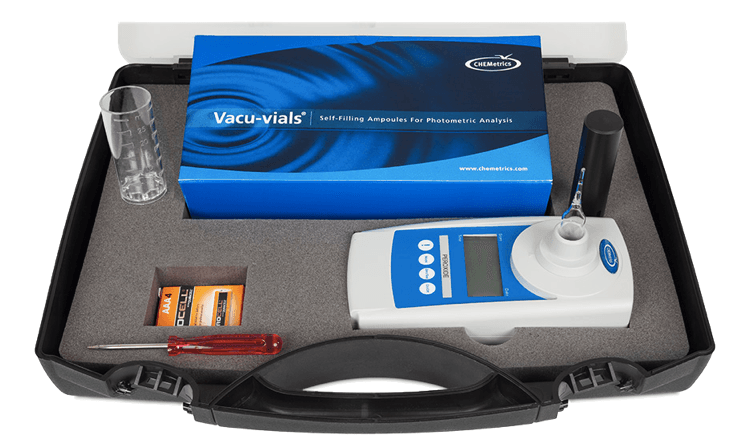
Spectrophotometers: High Accuracy, Lower Practicality
Spectrophotometers offer the most accurate and objective measurement of hydrogen peroxide levels.
They work by measuring light absorption at specific wavelengths to determine concentration, producing a clear digital result.
Advantages: ✔ High accuracy and repeatability ✔ Eliminates subjective interpretation ✔ Suitable across a wide concentration range
Limitations:
• High equipment cost
• Delicate testing cells prone to damage
• Less practical for routine site use across multiple engineers
While they represent best-in-class accuracy, they are not always suited to everyday field conditions.
So, What’s Best in Practice?
No single method is perfect, and relying on just one can leave gaps in accuracy or practicality.
A balanced approach is typically most effective, and at SafeSol, we suggest you:
• Use drop test kits to accurately measure concentrations at sentinel points
• Use test strips to confirm that peroxide is present and distributed throughout the system
This ensures you are not only dosing correctly, but verifying that the required concentration has been achieved where it matters most.
Final Thought
As expectations around disinfection validation continue to rise, particularly under LCA guidance, there is increasing emphasis on measuring - not estimating - hydrogen peroxide levels.
Because in disinfection, it’s not enough to dose the system - you need to prove the concentration is right.
Need Support with Disinfection or Testing?
Choosing the right testing method and ensuring accurate hydrogen peroxide levels can make a significant difference to the effectiveness of your disinfection.
If you’re unsure whether your current approach is giving you reliable results, or you’d like guidance on best practice for dosing, monitoring, or system setup, the team at SafeSol are always happy to help.
With extensive experience in Huwa-San application, system disinfection, and ongoing monitoring strategies, SafeSol can support you in making sure your processes are both effective and fully evidenced.
Because when it comes to disinfection, confidence comes from knowing your levels are right, not just assuming they are.


